Thousands of Mosman locals are currently taking urgent steps to secure their financial and personal identities after a third-party software provider exposed sensitive community data to cyber criminals.
Has your personal data fallen into the wrong hands? The local government is currently contacting affected individuals to explain exactly what information was accessed during a security failure that originally took place in May 2026. Panic is unnecessary. This is not a fresh attack.
Instead, authorities are simply following up on their previous public warnings to ensure the neighbourhood understands the exact scope of the software provider’s mistake.
Help is right around the corner. Recognising the intense stress of a privacy loss, council members arranged a special in-person support session on Friday, July 10. Between 9:30 a.m. and 10:30 a.m., state experts from ID Support NSW will sit down with residents at the Allan Border Oval Pavilion.
They provide completely free, personalised guidance to help restore compromised documents and block potential identity theft. Residents simply need to register beforehand by calling 9978 4128, emailing the community care team, or visiting the Seniors Centre.
So, what should you do right now? Stay vigilant. Scammers thrive on confusion, meaning everyone must ignore unexpected messages requesting financial details or containing strange links. Check your credit card statements for anything unusual. Enable multi-factor authentication everywhere possible and change your passwords immediately. Every small defence helps lock down your digital life while the investigation continues.
A new three-storey mansion in the harbourside suburb of Mosman has set a striking new benchmark for local luxury, arriving on the market with a $28 million price tag that highlights the area’s evolving character.
The property journey began decades ago when Kathleen Laurence bequeathed her original 1940s home to the University of Sydney, with the condition that her sister, Angela, could reside there for the remainder of her life. After that period concluded, the university held the land for half a century before selling it for $5 million in 2022.
Following that sale, the site underwent a complete change under the direction of Tony Antonios of ORO, who transformed the block into a modern residence that stands in stark contrast to the modest home that previously occupied the space.
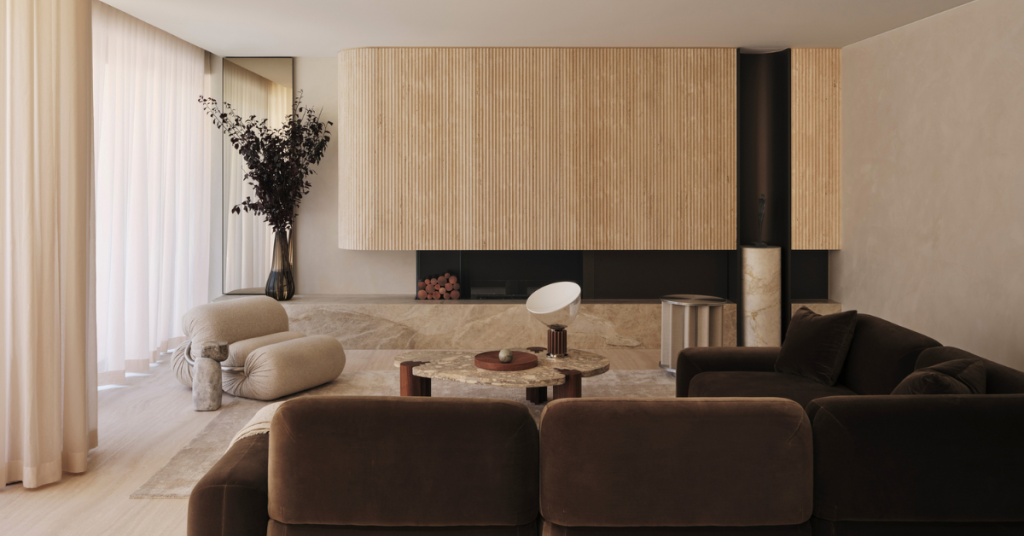
The new build occupies more than 1,030 square metres of land that directly borders the quiet surroundings of the Sirius Cove Reserve. The layout is designed to focus on high-end leisure and daily comfort, featuring a dedicated wellness wing equipped with a gym, a sauna, a steam room, and both hot and cold plunge pools.
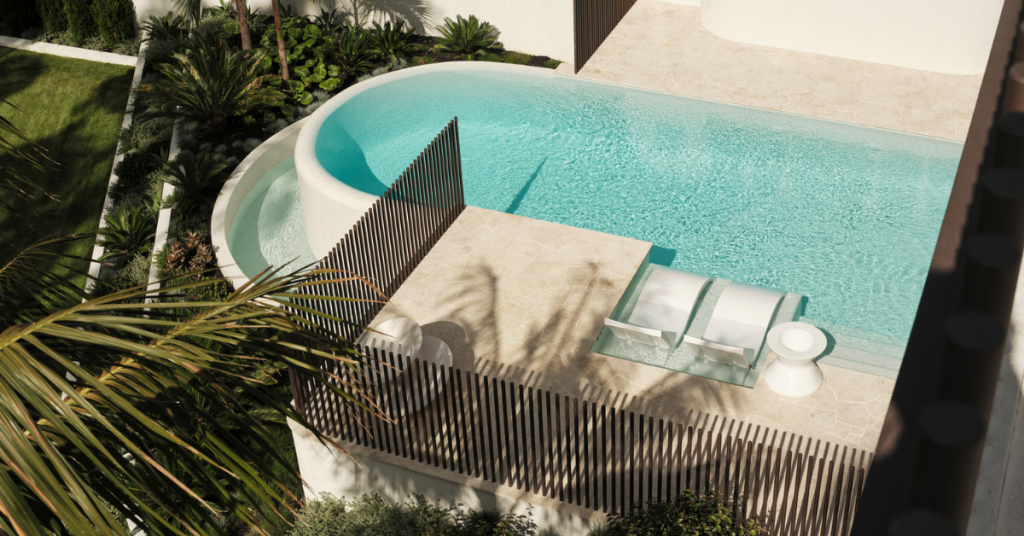
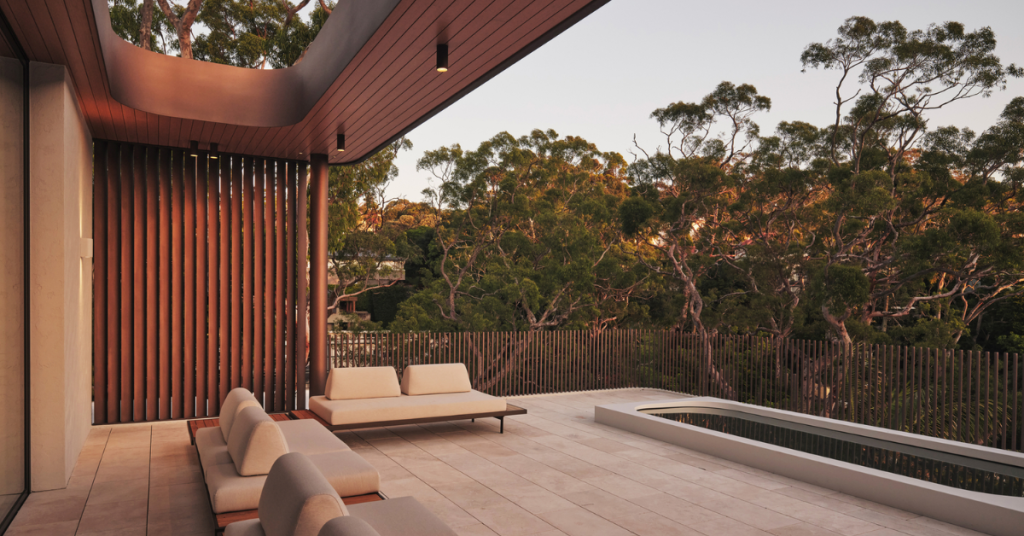
For entertainment, the home includes two separate cinema spaces, one positioned inside and the other designed for high-performance outdoor viewing. The exterior grounds further feature an illuminated infinity pool and a lounge area built around a firepit.
Inside, the home prioritises both convenience and scale, with a lift providing access to every floor. The kitchen serves as a primary feature of the interior, defined by a single piece of curved marble for the island bench, complemented by a concealed commercial-grade cooler room and a large butler’s pantry.
Each of the five bedrooms includes its own private ensuite, while the primary bedroom offers a large dressing room fitted with an illuminated cabinet for jewellery. The secondary spaces include a formal library, a sitting room, a wine cellar, and a spacious garage with a turntable to assist with vehicle movement.
Local interest in the property has been steady, with people who have toured the home noting the high standard of construction. Michael Coombs of Atlas, who is managing the sale, stated that the level of detail provided by the builders is unlike anything he has encountered during his 25 years working as an agent.
He observed that visitors often arrive expecting a standard high-quality build, but typically leave feeling that the property is one of the most impressive they have ever seen. The house has already become a frequent topic of conversation among residents in the surrounding suburbs.
Two Mosman residents have launched a paid walking bus service called walked.by, offering to escort local children to and from school for $5 per trip as a Term 3 pilot in the suburb.
Julia Edgar and Sophie Krynauw started the service after noticing that many children living close to school are still dropped off by car because morning schedules are so tight. Their answer is walked.by, a structured walking bus service that puts a trained adult in charge of a small group of children along a fixed neighbourhood route.
Mosman’s geography makes the concept unusually well-suited to the area. Five schools cluster around the village, including Mosman High at 769 Military Road, Mosman Public on Belmont Road, Sacred Heart on Cardinal Street, Mosman Prep on Shadforth Street, and Queenwood and Blessed Sacrament both on Queen Street.
Beauty Point and Middle Harbour public schools sit further north toward The Spit. In a suburb of just 8.7 square kilometres, most students already live within walking distance of their school gate.
A simple idea with a lot going for it
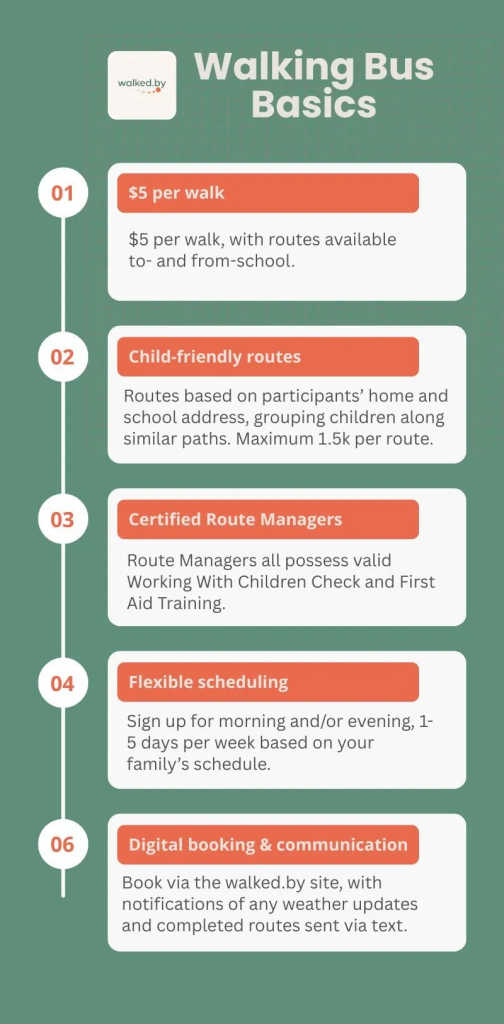
The walked.by model works like this: trained adults called Route Managers collect children from fixed pick-up points along a capped 1.5-kilometre route and walk them to school in the morning, then bring them home again in the afternoon. Every Route Manager holds a Working With Children Check and first aid certification.
Families choose the days that suit them, from one to five per week, and can book either the morning run, the afternoon run, or both. A text confirms when the route is complete.
The service covers children from Kindy through Year 7. The service costs $5 per walk, and registrations are now open for the Term 3 pilot starting in mid-July
Julia brings significant professional experience to the venture, having led marketing roles for Amazon, HSBC and T-Mobile, while Sophie spent close to two decades in financial services. Both are Mosman residents and parents who know firsthand what the morning looks like when logistics and time collide.
“Children who live five or ten minutes from their school arrive by car, because the logistics of the morning just don’t give families another option,” Julia said. “Walking has become something that happens when you have time, and nobody has time.”
More than just getting there on time
The case Julia and Sophie make goes well beyond solving a scheduling headache. They point to established research linking walking to school with sharper concentration, reduced stress and better road awareness in children, the kind of benefits that accumulate quietly over a school year but matter a great deal.
There is also an environmental angle. The founders estimate the Mosman pilot could remove around 16 tonnes of carbon from local roads, taking a meaningful bite out of the morning crawl along Military Road that anyone who has tried to cross it at 8:45am knows well.
“We’re not just solving a logistics problem,” Julia said. “We’re trying to help children build a healthy relationship with movement, with nature and with their community. That’s something you can’t get from the back seat of a car.”
If the Term 3 pilot goes well, walked.by plans to expand into after-school sport, care, and activity routes as well.
Joining the pilot or becoming a route manager
Mosman families with children in Kindy through Year 7 can register for the Term 3 pilot here. The site also carries a jobs page for anyone interested in becoming a paid Route Manager, a role that suits local residents who want flexible, community-connected work during school hours.
For general enquiries, the walked.by team can be reached at hello@walkedby.com.au. The service is based in Mosman NSW 2088 and is also on Instagram and LinkedIn.
Former prime minister Tony Abbott has thrown his support behind a growing Mosman campaign to stop the sale of part of HMAS Penguin, urging residents to prepare for a community fight to protect the military site and its adjoining angophora forest.
Hundreds of residents packed Mosman RSL for a community forum focused on the future of HMAS Penguin, highlighting concern over the proposal to divest part of the Middle Head naval base.
The gathering brought together campaigners, residents, and former politicians concerned about the future of the site’s angophora forest and surrounding bushland.
Photo credit: Google Maps/Nina Beilby
Mr Abbott, who represented Warringah in federal parliament for 25 years, told attendees that local residents may ultimately need to take visible community action if authorities proceed with plans to dispose of part of the site.
He suggested residents should be prepared to demonstrate their opposition in person, arguing the land should remain protected.
The former prime minister drew parallels with past community campaigns that successfully protected parts of Sydney from redevelopment, saying local people should not underestimate the power of collective action.
The campaign centres on part of the 16.64-hectare HMAS Penguin base at Middle Head, which was identified for partial divestment in the Commonwealth’s 2023 Defence Estate Audit.
The audit recommended the sale of dozens of Defence properties around Australia as part of a broader review of Defence assets.
Photo credit: Google Maps/Peter Murphy
While Defence has stated that key operations at HMAS Penguin, including clearance diver training and specialist underwater medicine facilities, would remain at the base, community groups say uncertainty remains over exactly which sections of land could be sold.
Particular concern has focused on approximately six hectares of angophora forest bordering the base. Campaigners say the forest has significant environmental value and forms part of a broader historic landscape at Middle Head.
The Headland Preservation Group argues the area sits within a precinct that includes military heritage sites, walking tracks and conservation areas overlooking Sydney Harbour.
Campaigners have launched an open letter calling on Prime Minister Anthony Albanese, Defence Minister Richard Marles, Finance Minister Katy Gallagher, Environment Minister Murray Watt and independent MP Zali Steggall to prevent any sale of the forested land.
Community concern has been building since reports emerged earlier this year that part of HMAS Penguin had been earmarked for disposal.
Since then, local residents have organised community meetings, open letters, and advocacy campaigns aimed at persuading the government to reconsider.
The federal government has maintained that Defence land identified for divestment could potentially provide greater public access in the future.
However, campaigners remain sceptical and are seeking assurances that the angophora forest and surrounding bushland will remain protected.
Officials have yet to release final details outlining the precise boundaries of any future sale. Until those plans are made public, community groups say they will continue pressing their case and encouraging residents to make their voices heard.
A Sirius Cove home designed by architect Susan Rothwell, which last changed hands for $13 million two years ago, will go under the hammer on-site this Saturday in what’s shaping up as a key gauge of confidence in the Mosman prestige market.
The five-bedroom property at 15A Clanalpine Street carries a guide of $14.5 million to $15.95 million through Anna Chen of BresicWhitney.
On-site auctions are something of a rarity for properties at this price point. Deals of this scale are typically hashed out behind closed doors rather than fought over in front of a crowd, which makes Saturday’s auction worth watching closely.
The sale comes hot on the heels of Sydney’s biggest auction result so far this year, with a six-bedroom harbourside home at 41 Vaucluse Road fetching $23.22 million under the hammer last weekend.
Vendor Paul Biller, of Biller Property, had originally floated a $22 million price tag for the Clanalpine Street home before settling on the auction format. He said the move was about manufacturing urgency around a firm deadline, rather than leaving the sale to drag on indefinitely.
It appears to be working. Four parties registered to bid and three went on to compete for the keys – a notable contrast to other homes on the same street that have languished on the market for months without finding a buyer.
Chen said interest in the home has been strong, particularly from buyers who are prioritising a family home over spreading their money across an investment portfolio. She pointed to the federal budget and broader economic conditions as a factor reshaping how wealthy buyers are thinking about where to park their capital.
According to Chen, high-net-worth buyers who once diversified their holdings widely are now leaning towards consolidating their wealth, with many already shifting capital back into their primary residence or planning to do so. She believes this trend will keep supporting demand for high-quality family homes as the market continues to adjust.
Council and sales records show the tri-level home was built in 2016 and purchased in February 2024 by Yahan Wang, a technology executive whose background is in AI-driven consumer products.
Constructed from sandstone, concrete and double brick, the property offers several distinct living zones and resort-style outdoor areas, all set behind tall hedges that shield it from the street. Despite its understated street presence, the home was designed to open up to sweeping views over Sirius Cove, with a pool and landscaped gardens completing the package.
Saturday’s result will offer fresh insight into how far buyers in Sydney’s prestige market are willing to stretch at a time when economic conditions are prompting many wealthy purchasers to rethink where they put their money.
North Shore Police say recent break-ins linked to luxury vehicle thefts have put Mosman residents on alert, with offenders entering homes at night to steal car keys before driving away in high-value vehicles.
According to information released by the North Shore Police Area Command, offenders have been entering homes during the night to obtain keys for vehicles including BMWs, Audis and Land Rover Discoverys. Police investigations indicate the offences are occurring while residents are asleep, with offenders attempting to avoid contact with occupants.
The warning follows a series of incidents reported across several North Shore suburbs, including Mosman, Kirribilli, Castlecrag, Lindfield and Greenwich.
Strike Force Sweetenham Examining Recent Incidents
The investigations are being led by Strike Force Sweetenham, a specialist police operation established to investigate aggravated break-ins and vehicle thefts involving luxury and high-performance vehicles.
North Shore Police Commander Superintendent Paul Devaney said investigators had recorded a noticeable increase in night-time break-ins linked to vehicle thefts in recent weeks.
Police believe some offenders are gaining entry through vulnerable access points around homes, including pet doors and side entrances, before searching for vehicle keys. Investigators suspect some of those involved are young people due to the methods being used to access properties.
Authorities have stated that in many cases the offenders appear focused on obtaining keys and leaving quickly rather than confronting residents.
Photo Credit: NSW Police/Facebook
Stolen Cars Often Found Damaged or Abandoned
Police say stolen vehicles are frequently used in dangerous driving incidents before being abandoned elsewhere across Sydney.
One of the incidents highlighted during the recent investigation involved Mosman resident Chris Yates, who had a BMW X6 and a Land Rover Discovery stolen after offenders entered his property during the early hours of the morning.
The BMW was later linked to a police pursuit before being found damaged and abandoned. The Land Rover was recovered separately. Investigators have also noted that some stolen vehicles may eventually be transferred through broader criminal networks operating across Sydney.
Police Urge Residents to Protect Keys and Entry Points
Police are encouraging residents to lock doors and windows before going to bed, secure pet doors where possible and keep vehicle keys away from entrances and visible locations.
Tracking devices are also being recommended for owners of luxury and high-performance vehicles, providing another way to assist investigations if a vehicle is stolen.
Superintendent Devaney has encouraged residents to report suspicious activity immediately, particularly unusual noises or movements around homes during overnight hours.
Community Awareness Remains a Key Focus
Local authorities and community leaders are supporting police efforts to raise awareness across affected suburbs.
Mosman Mayor Anne Marie Kimber said residents should remain aware of the risks associated with vehicle thefts and take practical steps to reduce opportunities for offenders.
Three Sparrows Books, Mosman’s only independent bookstore, has been shortlisted for the 2026 Australian Booksellers Association (ABA) Bookseller of the Year Award.
Owner Julia Cahill said the nomination was completely unexpected, describing the shop as feeling like “the little bookshop that could.”
The Military Road shop is one of four finalists selected from across the country, competing against Ink Bookshop (Mansfield, Victoria), Booktique (Albury, NSW), and Avid Reader (West End, Queensland).
Photo credit: Google Maps/Sandy Coutts
Three Sparrows Books opened in October 2022 at 836 Military Rd, after Mosman was left without an independent bookstore. The shop operates from 49 square metres, situated less than 100 metres from Harry Hartog, a national chain bookseller.
Cahill, who lives in Mosman, has said that her knowledge of the local community informs how she runs the store. Knowing customers by name and understanding local reading preferences, she has said, is something a chain store cannot replicate.
Photo credit: Google Maps/Andre Bahremand
The shop stocks Australian authors and runs a dedicated children’s section. It also maintains charity partnerships, with gift-wrapping profits directed to ReLove and an ongoing arrangement with Head High Skills. The store’s name, “Three Sparrows” references Cahill’s three sons, William, Sam, and Edward.
The ABA Text Publishing Bookseller of the Year Award is presented annually by the Australian Booksellers Association. It recognises outstanding individual achievement in bookselling over the preceding 12 months. The award acknowledges bookshops that have demonstrated high standards in retail bookselling while making a broader contribution to the book industry and their local communities.
The ABA Conference Gala Dinner, where the winner will be announced, is scheduled for Sunday 14 June in Canberra.
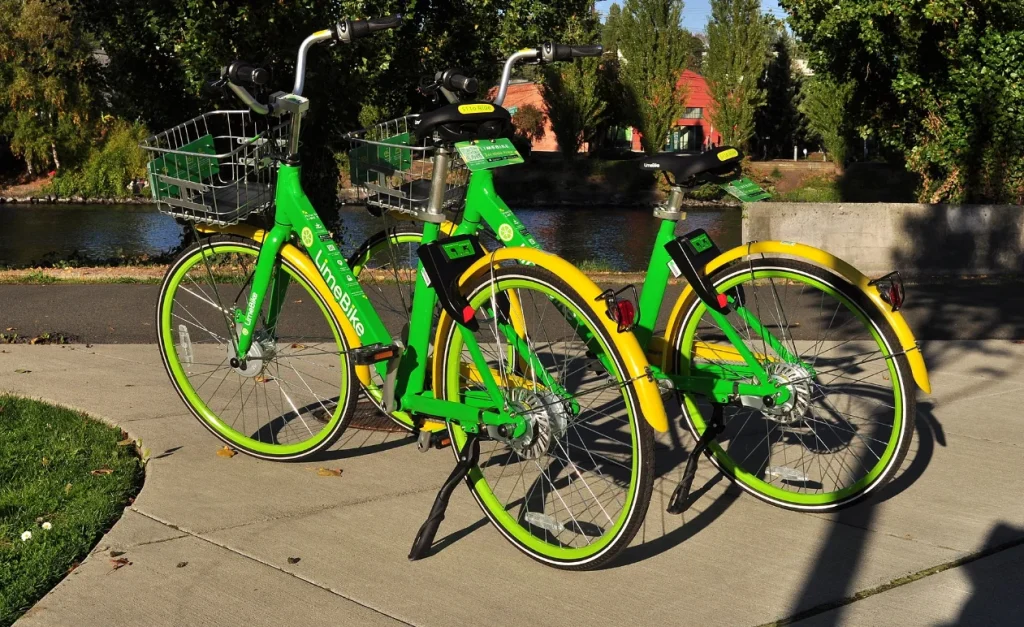
Mosman is preparing for the arrival of Lime e-bikes through a managed rollout, with parking controls, geofencing and public safety measures expected to shape how the service operates around beaches, wharves and busy local areas.
Mosman Lime E-Bike Rollout Moves Ahead With Local Controls
Lime e-bikes are expected to move into Mosman through a gradual soft launch, after a structured approach was endorsed for their proposed introduction.
The plan centres on lifting geofencing restrictions near Spofforth Street, allowing bikes already operating in the adjoining North Sydney area to enter Mosman through normal rider movement. Under this approach, Lime would not place bikes directly in Mosman at the start. Instead, their presence would build gradually from nearby operating zones.
Lime already operates in North Sydney and Manly, where shared e-bikes have become a familiar transport option. Their expected arrival in Mosman has prompted both interest and concern, particularly around where the bikes will be parked and how high-use public areas will be managed.
The endorsed approach recognises that the request cannot be unreasonably refused, while setting a framework aimed at balancing active transport options with safety, amenity and compliance.
Parking And Geofencing Set To Shape Mosman Use
The main local issue is how the bikes will be managed once they begin appearing in Mosman.
Concerns identified in local planning material include footpath obstruction, visual clutter and the management of bikes around foreshore and high-use public areas. Balmoral and Clifton Gardens fall within the type of locations expected to require close attention because of their public use and beachside setting.
Designated parking would be limited to selected strategic locations, including Mosman Bay Wharf, B-Line stops, beaches and commercial centres. Parks, ovals and sensitive public spaces are expected to be treated as no-go zones through geofencing.
A proposed map of parking locations and operating areas is also expected to guide the rollout before bikes begin moving into Mosman in larger numbers.
Mosman’s planned controls are partly shaped by the experience of nearby North Sydney, where Lime’s November 2024 rollout raised early concerns about bikes being left in unsafe or inconvenient locations.
More than 100 bikes were moved in one month after being identified as public safety risks. That experience has added weight to local concern about whether shared e-bikes can be managed without blocking footpaths, verges or other public spaces.
Public reaction has been mixed. Some residents see the bikes as a useful way to make short trips, reach beaches and avoid parking pressure. Others are concerned about bikes being left across footpaths, in cul-de-sacs, on grass verges, near parked cars or in areas where pedestrians need clear access.
Helmet use and proper parking have also emerged as points of concern in public discussion.
Cost And Compliance Remain Key Questions
Under the proposed fee model, operators would pay 80 cents per trip. Transport for NSW would retain 60 cents, while 20 cents would go towards local enforcement, complaints and infrastructure costs.
Mosman’s planning material warns that this amount may not fully cover the cost of managing the service. That makes compliance, monitoring and response times important parts of the rollout.
Lime has indicated that improperly parked bikes are generally removed within four hours. The practical test for Mosman will be whether parking zones, geofencing and response systems are enough to manage the service without creating avoidable problems in busy public areas.
Mosman is preparing for Lime e-bikes as a managed transport change rather than a direct fleet drop. The strongest focus is expected to remain on beaches, wharves, commercial centres and other places where public access and clear pathways matter most.
For many Australians, an Indian menu can feel intimidating at first glance. Makhani. Rogan josh. Saag. Vindaloo. While these words are familiar, they aren’t always easy to decode. Venues like Phulkari Indian Cuisine are changing that.
Beyond the butter chicken and garlic naan most diners already know, Phulkari’s venues showcase how North Indian cuisine actually works—through smoke, spice, texture, slow cooking, and balance.
The Phulkari story began at its flagship Balgowlah location on Sydney Road, a neighborhood hub built on a multi-generational family restaurant legacy. While Balgowlah anchors the brand’s heritage with its relaxed courtyard setting, its sister venues branch out into distinct directions: the Frenchs Forest location leans heavily into vibrant street food and sharing-style plates, while the Mosman restaurant presents many of the same flavours through a contemporary evening dining experience, pairing classic curries with cocktails and wine.
Across all three locations, Phulkari dispels a common myth: North Indian food is not built around extreme heat. Instead, it focuses on warmth, aroma, and richness, layered through cream, tomatoes, yogurt, lentils, charcoal smoke, and balanced spice blends.
Learning the “Language” of the Menu
Once you understand the terminology behind North Indian cooking, ordering becomes second nature. Certain words immediately signal how a dish is prepared:
Tikka: Refers to marinated meat or paneer cooked inside a tandoor (clay oven), giving it a smoky edge. Chicken tikka is served grilled, while chicken tikka masala folds those smoky pieces into a rich sauce.
Makhani: Derived from the Hindi word for butter, these dishes feature rich, tomato-based sauces layered with cream and aromatic spices.
Korma: A softer, creamier curry built around a cashew paste designed to mellow the spices rather than intensify them.
Vindaloo & Madras: Signals higher heat and sharper spice, with Madras often carrying warmth from chilli and coconut.
Paneer: Refers to the use of fresh, unaged cheese, with a mild, milky flavor and a dense, chewy texture similar to firm tofu. Paneer absorbs flavors beautifully and does not melt when cooked, it is a primary source of protein in Indian vegetarian cooking.
Rogan Josh: Features deep, aromatic flavours rooted in Kashmiri traditions.
Saag: Refers to blended leafy greens (usually spinach). Dishes like lamb saag or palak paneer develop richness through greens and gentle spice rather than tomato gravies.
Aloo: Refers to the inclusion of potato in the dish. Saag aloo, for example, features leafy greens (saag) and potatoes (aloo). Not to be confused with vindaloo.
A Rich Vegetarian Tradition
North Indian cuisine treats lentils and vegetables as centrepieces rather than meat substitutes. This is best seen in dal makhani, where black lentils and kidney beans are slow-cooked for hours until thick, creamy, and deeply savory.
The Art of Chaat and the Tandoor
To truly understand North Indian dining, you have to look at two culinary pillars: the street-food culture and the clay oven.
1. The World of Chaat
While available as popular starters at Balgowlah, chaat (street food) takes center stage at Frenchs Forest. Built entirely on contrast, dishes like samosa chaat and papri chaat collide crisp pastry, cool yoghurt, fresh herbs, tangy tamarind, and chickpeas into a single bite—sweet, tangy, crunchy, and creamy all at once.
2. The Power of the Tandoor
The tandoor sits at the heart of the kitchen, cooking at extreme temperatures to create the distinct char and smokiness found in seekh kebabs and fresh tandoori breads. Breads are integral to the meal, acting as utensils to scoop up rich sauces:
Naan: Soft, leavened, and rich.
Garlic naan
Roti: Light and wholemeal-based.
Paratha: Layered, flaky, and buttery.
One Philosophy, Two Distinct Experiences
While the core cooking philosophy remains consistent, Phulkari subtly adapts its menu to suit each neighbourhood:
Phulkari Balgowlah
Phulkari Frenchs Forest
Phulkari Mosman
The Heritage Anchor: Relaxed, neighborhood-focused atmosphere with a covered courtyard.
The Street Food Hub: Casual, lively vibe with a strong emphasis on sharing-style chaat.
The Refined Date Night: Contemporary evening dining paired with a curated cocktail and wine list.
In all venues, the emphasis remains on balance. Newer diners are often surprised to find that the food relies on depth of flavour rather than aggressive chilli.
How to Explore Further
Most people start with the familiar trilogy: butter chicken, garlic naan, and saffron rice. However, understanding the menu structure allows diners to build a table based on contrast rather than ordering competing dishes.
If you want smokiness, look to the tandoor. For comforting richness, choose a korma or dal makhani. For bright, punchy spice, explore vindaloo or Chettinad-style curries.
Butter chicken may be the gateway, but Phulkari reveals just how vast the cuisine can be. Backed by a kitchen team that has remained with the restaurant for over a decade, Phulkari ensures that, whether you are dining at the original Balgowlah location, grazing on chaat in Frenchs Forest, or having an evening out in Mosman, you are getting a true map of North India’s flavours.
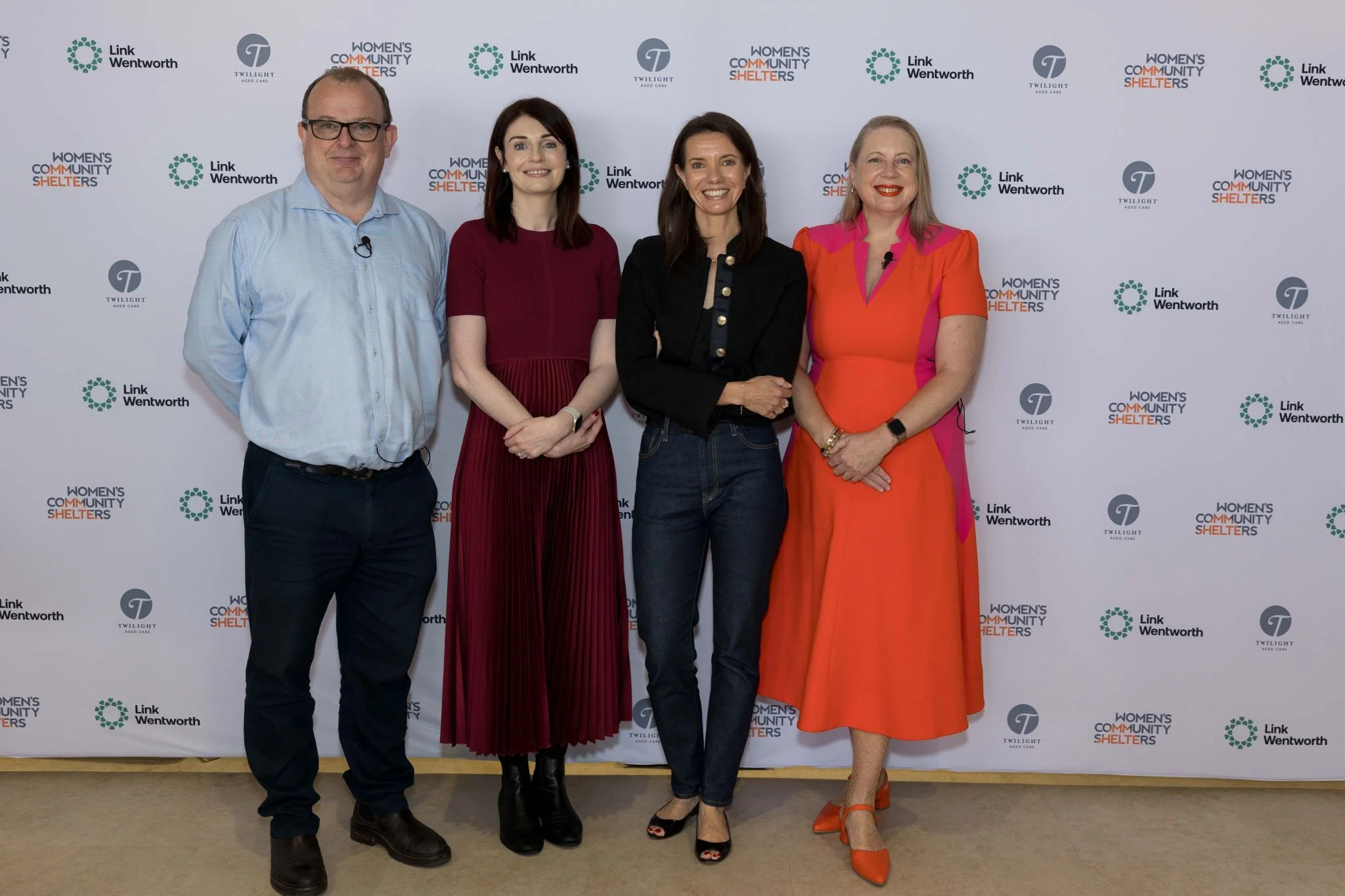
A vacant former retirement home in Mosman became more than an unused building awaiting its next purpose. Over five years, it was transformed into a place of safety for older women facing housing insecurity, delivering more than 25,000 safe nights and helping many residents move towards permanent housing.
Between 2020 and 2025, Mosman House turned an empty former retirement home into 18 transitional homes for women aged 50 and over.
The project supported 57 women during that period, using a Meanwhile Use housing model that allowed an unused property to provide short- to medium-term accommodation while longer-term plans for the site remained ahead.
Photo Credit: Link Wentworth/LinkedIn
It was a practical idea with a deeply human outcome. Rooms that may otherwise have sat empty instead became places where women could pause, regain stability and begin working towards a more secure future.
Mosman House was delivered through a partnership between Link Wentworth, Women’s Community Shelters and Twilight Aged Care, with support from corporate and philanthropic donors.
Safety, Stability And A Pathway Forward
The women who stayed at Mosman House ranged in age from 50 to 81, with an average age of 59. Many arrived after facing circumstances that made secure housing difficult to access.
Affordability pressures were the most common barrier, affecting 42 per cent of residents. Domestic and family violence accounted for 23 per cent, while financial hardship accounted for 20 per cent.
The project was designed to bridge the gap between crisis accommodation and permanent housing. It offered residents a stable place to stay while support was provided to help them work towards longer-term accommodation.
One former resident shared how Mosman House supported her after unexpected life events left her without stable housing. Her experience reflected the broader purpose of the project: not only to provide temporary shelter, but to give women a safer setting while they rebuilt their next steps.
More Than 25,000 Safe Nights In Mosman
Across five years, Mosman House delivered more than 25,000 safe nights for vulnerable older women.
The outcomes showed the strength of the model. Eighty-four per cent of women who stayed at Mosman House were offered safe, permanent housing after their time in the program.
The project also operated at $46.75 per bed night. That was lower than Women’s Community Shelters’ 2025 average crisis shelter bed night of $130 and the temporary accommodation sector average of $165 listed in the project material.
Beyond the housing figures, the project also created lasting social connections. Many residents remained in touch after leaving the program, showing how a safe housing setting can support connection as well as accommodation.
Photo Credit: Link Wentworth/LinkedIn
A Practical Model With A Human Result
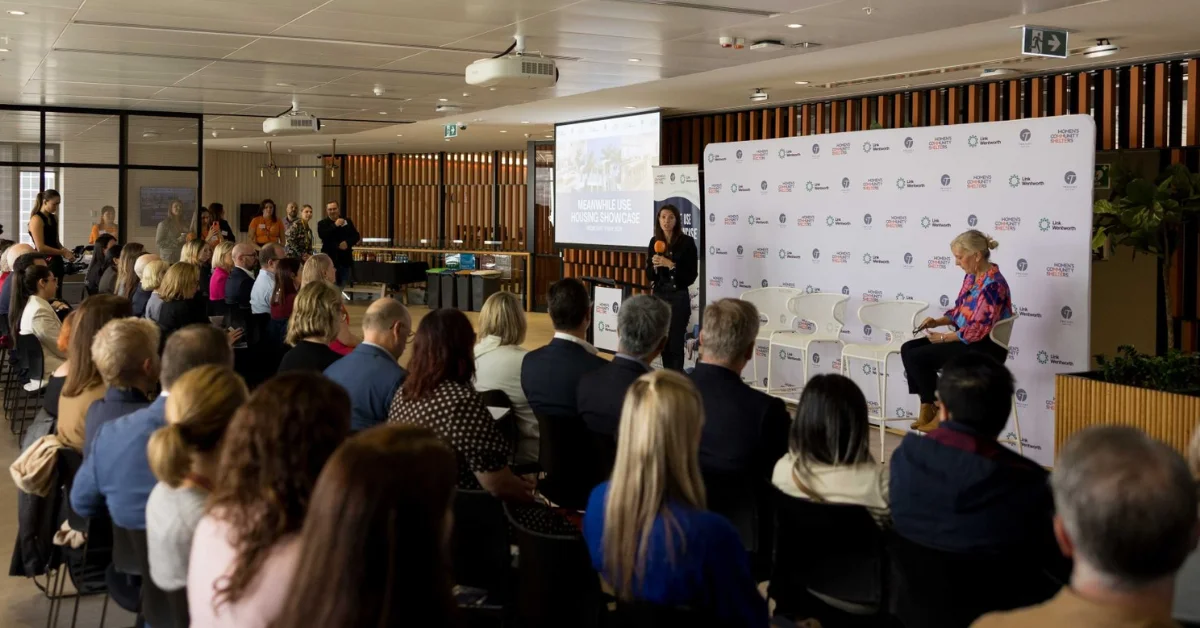
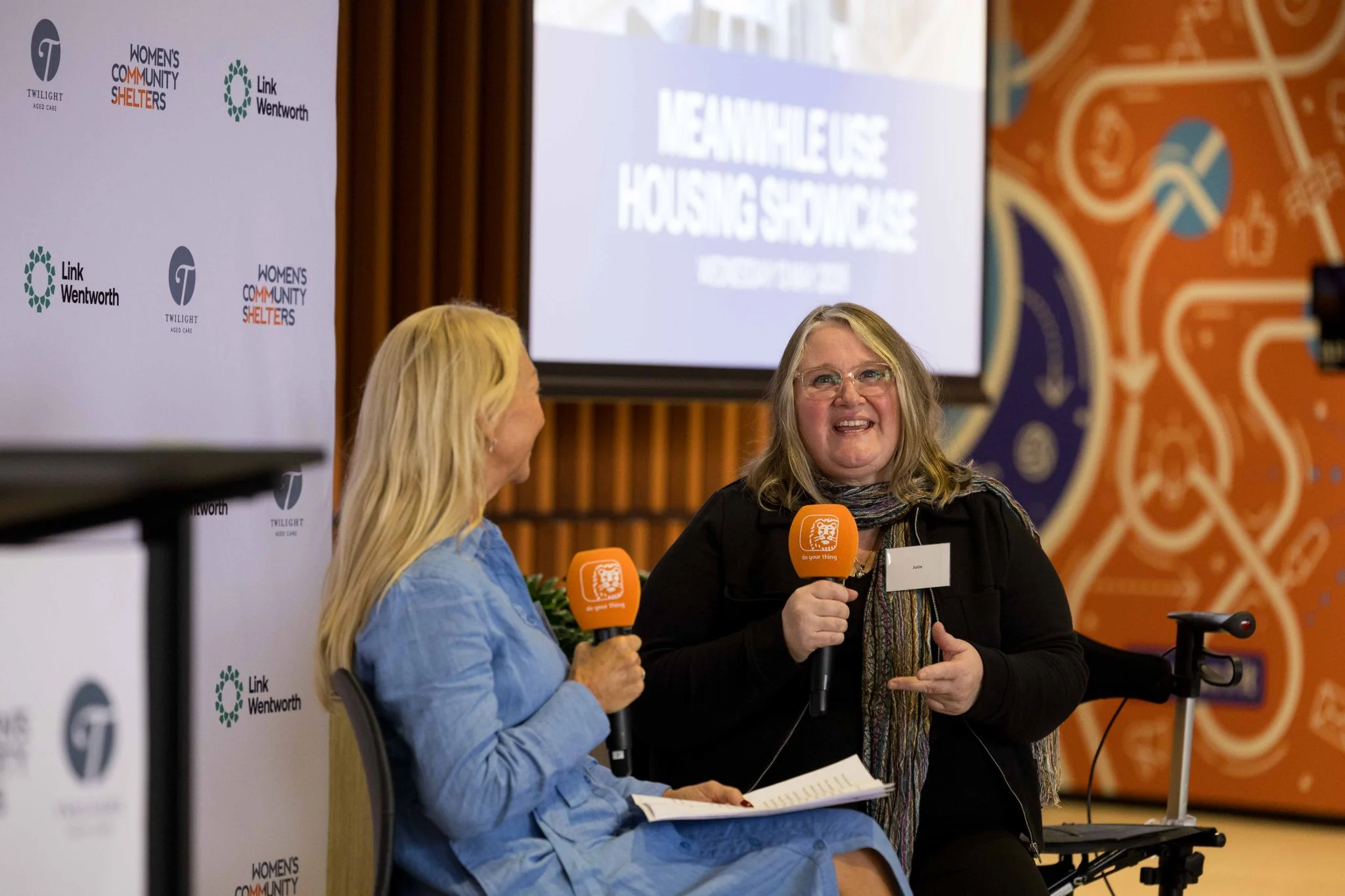
Mosman House has since been presented as a case study in Meanwhile Use housing. Its success came from a simple but powerful idea: an empty property could be used to meet immediate housing need instead of remaining unused.
For the women who stayed there, the project offered safety during periods of instability. For the organisations behind it, Mosman House showed how vacant buildings can be temporarily adapted into meaningful accommodation while permanent housing options are pursued.
The result was not only measured in homes, costs or program figures. It was also seen in the thousands of nights where older women had a safe place to sleep, steady support around them, and a clearer path towards secure housing.